
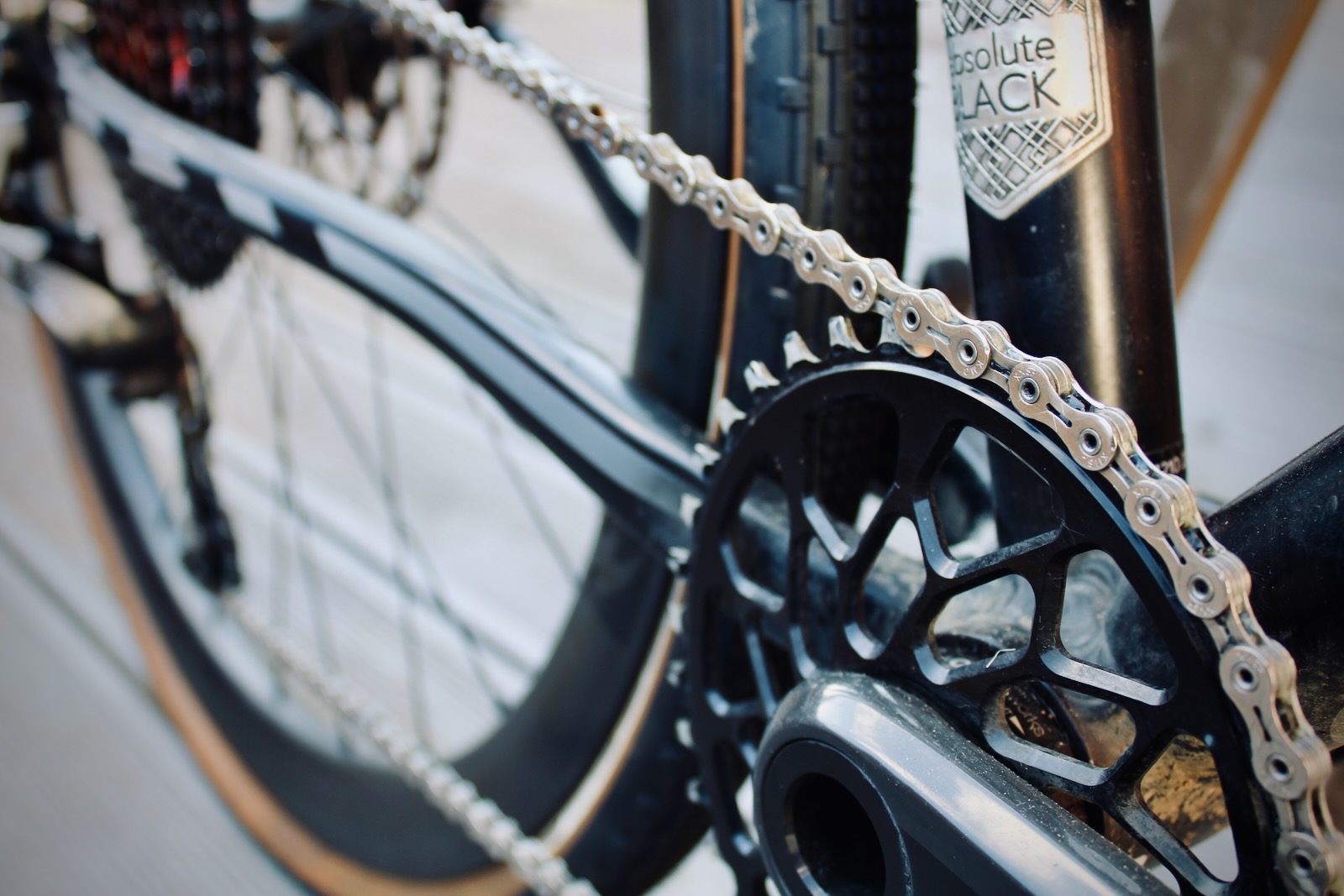
The Mistake Almost Every Cyclist Makes
Most cyclists replace their chain when gears start skipping or the drivetrain gets noisy. By that point, the cassette is already damaged.
A worn chain does not announce itself loudly. It elongates over thousands of miles, grinding down cassette teeth the whole time — teeth that cost five to ten times more to replace than the chain itself. The skipping gears you finally noticed? That is your cassette telling you it is too late to save it.
Chain replacement is a measurement task, not a feel task. You need a number, not a noise.
Why Chains Wear Out — The Mechanics Behind “Chain Stretch”
It is not actually stretching
The term “chain stretch” is misleading. The steel links themselves do not deform. What happens is that the metal pins and inner plates wear down at every pivot point — very slightly, with every pedal stroke. A standard 116-link chain has 232 pivot points. Each one accumulates microwear simultaneously.
On a new chain, the distance between link centers (the pitch) is exactly 0.5 inches (12.7mm). After use, cumulative pin wear makes the effective pitch longer across the full chain. Engineers express this as a percentage: a chain at “0.5% wear” measures half a percent longer than its original spec across its full length.
Why the 0.5% threshold is the number that matters
At 0.5% elongation, the chain is worn but the cassette is still mostly intact. Replace now and you keep the cassette.
At 0.75%, the cassette teeth have started conforming to the worn chain’s altered pitch — reshaped by thousands of revolutions against the wrong geometry. You can often still get away with only a new chain at this point, but you are pushing it.
At 1.0%, the cassette teeth have been filed to match the worn chain’s pitch exactly. A fresh chain at the correct 0.5-inch pitch will skip under load immediately. You are now replacing both components whether you planned to or not.
Most mechanics use 0.5% as the replacement threshold for 11- and 12-speed setups — Shimano 105, Ultegra, SRAM Rival, Force — and 0.75% for 8- and 9-speed drivetrains where cassettes are cheaper and chains are physically thicker.
Lubrication affects wear rate significantly. A dry, poorly lubricated chain wears two to three times faster than a clean, well-oiled one. In wet conditions — winter commuting, trail riding in rain — a chain that would last 2,500 miles in dry conditions might wear out in under 1,000 miles. Wet-climate riders should check chain wear more often, not less.
How to Measure Chain Wear and Know When to Act
The ruler method — and why it fails you
You can check chain wear with a standard ruler. Lay the chain flat and measure 12 inches from the center of one pin to another on a new chain. After use, if that same span now measures 12⅛ inches (12.125″) or more, the chain is past 1.0% wear.
The problem: this method only catches chains that are already overdue. The critical 0.5% and 0.75% thresholds are invisible to a ruler. Use it only as a last-resort confirmation that an obviously old chain needs replacing — not as your routine check.
Chain wear checkers worth buying
A dedicated checker costs less than the chain it protects. It reads both key thresholds accurately in about ten seconds.
The Park Tool CC-3.2 ($12–$15) is what most professional bike shops use. Two ends: one marked 0.5%, one marked 0.75%. Hook it into the chain and see if the pin drops into the link gap. Fast, accurate, and practically indestructible. This is the one to buy.
The KMC Chain Checker Plus II ($15–$18) does the same job with a clearer visual display. Works on 6- to 12-speed chains. If you prefer a clearer read over the Park Tool’s tactile feedback, the KMC is a solid alternative.
The Shimano TL-CN42 ($10) is functional for 8- and 9-speed setups. Less precise at the fine tolerances of 11- and 12-speed drivetrains — not the tool to reach for if you are running Ultegra or above.
The Birzman Feeler Chain Wear Indicator ($20–$22) has separate calibrated notches for 10-, 11-, and 12-speed chains with clearly labeled markers. Overkill for most riders, but worth it on expensive 12-speed setups like SRAM Eagle AXS or Shimano Dura-Ace Di2, where the cost of a cassette makes precision at the 0.5% mark genuinely critical.
Avoid unbranded checkers under $5. Several widely reviewed on cycling forums have been found out of tolerance — giving false “chain is fine” readings when the chain is actually at 0.8% or higher.
Chain wear thresholds by drivetrain speed
| Drivetrain Speed | Replace At | Cassette Cost If Late | Typical Chain Life | Common Groupsets |
|---|---|---|---|---|
| 6/7/8-speed | 0.75% | $15–$30 | 2,000–4,000 miles | Shimano Tourney, Altus, Acera |
| 9-speed | 0.75% | $20–$40 | 1,500–3,000 miles | Shimano Sora, Alivio; SRAM 9-speed |
| 10-speed | 0.5–0.75% | $30–$60 | 1,500–2,500 miles | Shimano Tiagra; SRAM Apex 10 |
| 11-speed | 0.5% | $50–$120 | 1,200–2,500 miles | Shimano 105, Ultegra; SRAM Rival, Force |
| 12-speed road | 0.5% | $100–$250+ | 1,000–2,000 miles | Shimano Dura-Ace, GRX; SRAM Red |
| 12-speed MTB | 0.5% | $90–$300 | 500–1,500 miles | Shimano SLX, XT, XTR; SRAM Eagle |
The pattern is consistent: more speeds means narrower chain means tighter replacement intervals. An 11-speed chain runs about 5.5mm wide. A 6-speed chain is closer to 8mm. Less material to absorb wear means the pitch tolerance breaks down faster.
Average chain life varies enormously by conditions. Check every 300–500 miles rather than trying to predict it by mileage alone. A dry-climate road rider doing 100 miles per week might get 2,500 miles from a chain. A wet-climate winter commuter might see 800.
The Failure Cascade When You Run a Chain Too Long
Running a chain past 1.0% wear is the most expensive maintenance mistake you can make on a bicycle. Here is the sequence, in order:
- Cassette teeth wear first. The elongated chain’s pins contact the wrong face of each sprocket tooth, slowly filing them into a hooked shape. A Shimano 105 cassette (CS-R7100) costs $55–$65. An Ultegra CS-R8100 runs $95–$120. A SRAM Force XG-1270 12-speed cassette is $160+. One overdue chain replacement can force any of those purchases.
- Chainrings follow — more slowly. Chainrings are under more load than cassette cogs and take longer to show damage, but they get there. Expect visible wear after two or three worn chains on the same rings. Shimano 105 chainrings cost $45–$90 per ring. SRAM Red AXS chainrings run $120–$200.
- New chain, worn cassette — immediate skipping. Install a fresh chain on a worn cassette and it will skip under hard effort right away. The new chain’s correct 0.5-inch pitch does not match the reshaped teeth. You are now replacing both at once, which you could have avoided by catching the chain at 0.5% wear.
- The silent damage problem. Worn drivetrains often shift acceptably right until they do not. The damage accumulates invisibly for hundreds of miles. Hard pedaling efforts — sprinting, climbing out of the saddle, accelerating hard from a stop — are usually the first moment skipping becomes obvious. By then, the cassette is already finished.
- Total cost in numbers: Chain replaced on time ($20–$40) versus chain plus cassette ($70–$200+) versus chain plus cassette plus chainrings ($150–$400+). The chain wear checker at $12–$15 pays for itself the first time it saves a cassette.
Do You Need a New Cassette When You Replace the Chain?
If the old chain was past 0.75% wear before you replaced it, test the cassette before assuming you are clear. Do not guess.
The pull test
Install the new chain and shift into the largest rear cog. Hold the chain against the cog and try to pull it radially outward — away from the sprocket surface. A healthy cassette will not let the chain lift more than a few millimeters. If the chain pulls away by half a link length or more, the teeth have been worn into a profile that will not grip a new chain reliably under load.
The under-load test
Take the bike out and ride at normal effort, then apply serious pressure. Sprint briefly or stand and climb a short hill. No skipping under hard effort means the cassette is fine. Skipping or surging under load means the cassette needs replacing regardless of what the pull test suggested.
When to replace both without testing
If the old chain was at or past 1.0% wear when you finally caught it, skip the tests and replace the cassette too. On 8- and 9-speed drivetrains where cassettes cost $20–$40, the decision is obvious. On 11- and 12-speed systems where cassettes run $50–$200+, the cost stings — but not as much as installing a new chain, discovering it skips under load, and doing the whole job over again.
What about the chainrings?
Chainrings outlast cassettes by two to three chain replacement cycles under normal riding conditions. Check the tooth profile by eye: healthy teeth are symmetrical and square-topped. Worn teeth look hooked or pointed on the trailing face — the shark-fin shape. If a fingernail catches on the back edge of a tooth, it is done. Shimano’s outer rings on the 105 R7100 12-speed crankset typically reach this stage around 10,000–12,000 miles of hard road use.
Replacement Chains: What to Buy for Your Drivetrain
Match your speed count. Do not mix incompatible standards. Do not overpay for a chain when the cassette is what you are actually protecting.
| Chain | Speed | Price | Best For | Verdict |
|---|---|---|---|---|
| Shimano CN-HG601 | 11-speed | ~$20 | Budget 105/Ultegra road builds | Solid entry option; OEM-grade reliability |
| Shimano CN-HG701 | 11-speed | ~$28–$32 | 105/Ultegra road and gravel | Best all-round 11-speed chain for most riders |
| KMC X11EL | 11-speed | ~$30–$35 | Shimano and SRAM compatible | Quick-link included; slightly lighter than Shimano equivalent |
| SRAM PC-1130 | 11-speed | ~$20 | SRAM Rival/Apex 11-speed builds | Budget-friendly; stay within SRAM drivetrains |
| Shimano CN-M7100 | 12-speed MTB | ~$35 | SLX/XT trail builds | Best value for 12-speed mountain bikes on Shimano |
| KMC X12 | 12-speed | ~$35–$40 | Road and MTB 12-speed, cross-brand | Cross-compatible; quick-link standard included |
| Connex 11sX | 11-speed | ~$40 | High-mileage commuting and touring | Claimed longer wear life; well-regarded for long-distance use |
For most 11-speed road riders, the Shimano CN-HG701 at around $30 is the correct choice. It is OEM-equivalent for 105 and Ultegra drivetrains, works with SRAM 11-speed without modification, and does not require anything special beyond proper lubrication. The KMC X11EL at $35 is worth the extra five dollars if you want an easy quick-link removal and a small weight reduction.
For 12-speed mountain bikes on Shimano drivetrains, the CN-M7100 at $35 covers SLX and XT without overpaying. Running SRAM Eagle? Stay within the SRAM PC-12 chain family or use the KMC X12 — Eagle AXS tolerances are tight enough that chain compatibility genuinely matters here in a way it does not on older drivetrains.
The Connex 11sX is worth considering for commuters and tourers who want longer chain life between replacements. At $40 it costs more upfront, but it carries a solid reputation for durability over very high mileage and the extra cost is easily justified on a bike covering 5,000+ miles per year.
Quick reference summary:
- Check chain wear every 300–500 miles — every 200 miles in wet or muddy conditions
- Use a Park Tool CC-3.2 ($12–$15) or KMC Chain Checker Plus II ($15–$18)
- Replace 11- and 12-speed chains at 0.5% wear; 8- and 9-speed chains at 0.75%
- A chain past 1.0% wear almost always means cassette replacement too — test before assuming otherwise
- Best 11-speed road chain: Shimano CN-HG701 (~$30) for most riders; KMC X11EL if you want a quick-link connector
- Best 12-speed MTB chain: Shimano CN-M7100 (~$35) for Shimano builds; stay within SRAM for Eagle drivetrains
