
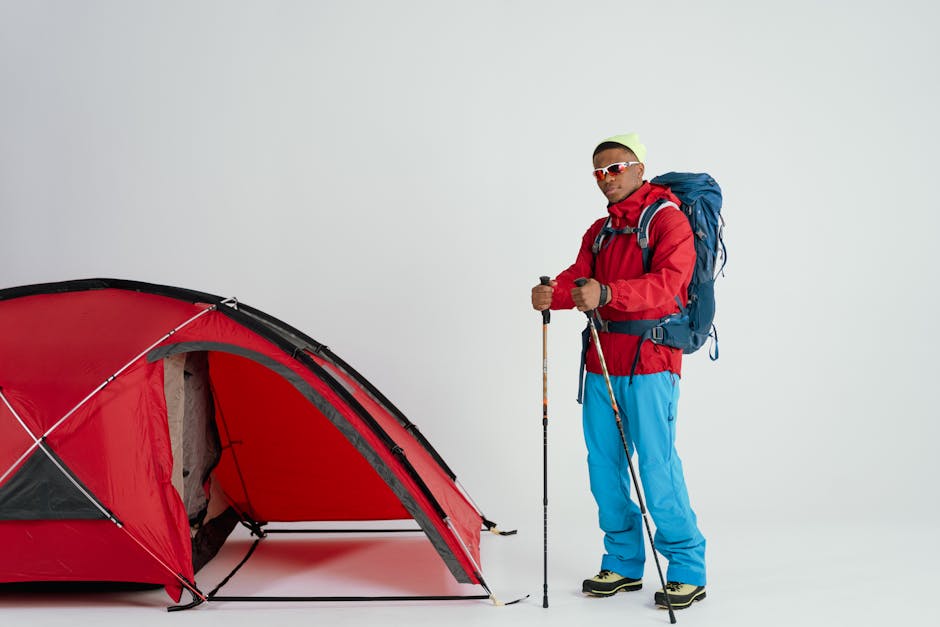
I’ve been buying outdoor gear for 12 years. I’ve owned tents that collapsed in wind, sleeping bags rated for 20°F that left me shivering at 35°F, and boots that blistered my heels after 3 miles. Most of those mistakes trace back to the same five errors at the gear shop. Here’s what I learned the hard way so you don’t have to.
Mistake #1: Buying a Sleeping Bag by Temperature Rating Alone
You see a sleeping bag rated for 20°F. It costs $120. You buy it. You freeze at 30°F. This is the single most common gear failure I see.
The problem: temperature ratings are tested with a sleeping pad (R-value matters), a base layer, and often a tent. No one tells you that the “comfort” rating is usually 10–15°F warmer than the “lower limit” rating. The EN 13537 standard has three numbers: comfort, lower limit, and extreme. Most brands advertise the lower limit. That’s the temperature at which a man can survive 8 hours without hypothermia — not sleep well.
I use the Mountain Hardwear Lamina 15°F ($200) for three-season camping. Its comfort rating is 25°F. In reality, I sleep warm down to 28°F with a good pad. For winter, the Western Mountaineering Antelope 0°F ($650) is my go-to — comfort rating is 10°F, and that’s accurate. But I paid $650.
What to do instead: Buy a bag rated 10–15°F lower than the coldest temperature you expect. If you camp at 30°F, buy a 15°F bag. Then check the comfort rating, not the limit rating.
How Sleeping Pads Change Everything
A sleeping pad with R-value below 3 will suck heat out of you even in a 0°F bag. The ground is a heat sink. I use the Therm-a-Rest NeoAir XTherm ($220, R-value 6.9) for cold weather. For summer, the Nemo Switchback ($50, R-value 2.0) is fine. But don’t pair a 20°F bag with an R-value 1.5 foam pad and expect warmth. That combo is good for about 45°F, max.
Mistake #2: Buying a Backpack That Fits Your Torso Length but Not Your Hip Shape
I sold gear at an REI for two years. I watched hundreds of people try on backpacks. They’d measure torso length, adjust the hip belt, and walk away happy. Then they’d come back after one trip with bruises on their iliac crests.
The hip belt is where 80% of your pack weight should rest. If the belt doesn’t wrap around your hip bones snugly — not too high, not too low — you’ll carry weight on your shoulders. That hurts. A lot.
Osprey makes excellent packs but their hip belts run narrow. If you have wider hips, try Gregory or Deuter. I wear a Gregory Baltoro 65 ($330) in size M/L. The hip belt wraps my iliac crest perfectly. My friend with a narrower frame loves the Osprey Atmos 65 AG ($280). We swapped packs for a day hike. I hated his. He hated mine.
What to do instead: Load the pack with 30 pounds in the store. Walk around for 15 minutes. Adjust the hip belt so it sits on your hip bones, not above them. If the belt doesn’t contact your hips on the sides, that pack is wrong for your body shape. Move on.
The One Feature Nobody Talks About: Load Lifters
Those straps at the top of the shoulder straps? They pull the pack closer to your back. Most people ignore them. A properly adjusted load lifter makes a 40-pound pack feel like 30. Tighten them until the shoulder straps lift slightly off your shoulders at the top, but still contact at the bottom. That’s the sweet spot.
Mistake #3: Buying a Tent Based on Capacity Numbers
A “3-person” tent fits 3 people if they are very close friends who don’t mind sleeping on their sides with no gear inside. In reality, a 3-person tent fits 2 people plus gear comfortably. This is an industry-wide lie and everyone knows it.
| Stated Capacity | Actual Comfortable Capacity | Floor Area (sq ft) | Example Tent | Price |
|---|---|---|---|---|
| 2-person | 1 person + gear | 28–32 | MSR Hubba Hubba NX 2 | $450 |
| 3-person | 2 people + gear | 38–42 | Big Agnes Copper Spur HV UL3 | $550 |
| 4-person | 3 people + gear | 50–55 | REI Co-op Base Camp 4 | $400 |
I use the MSR Hubba Hubba NX 2 ($450) for solo trips with gear. Floor area is 29 sq ft. That’s tight for two people plus a dog. For two people, I use the Big Agnes Copper Spur HV UL3 ($550) — 41 sq ft of floor space, two doors, two vestibules. That works.
What to do instead: Buy one size larger than the number of people sleeping in it. Two people? Buy a 3-person tent. Three people? Buy a 4-person. Your gear needs floor space too. And if it rains, you want room to sit up and cook inside without touching the walls (condensation is real).
Vestibule Space Is the Hidden Variable
A tent’s vestibule is where you store boots, packs, and wet gear. The MSR Hubba Hubba has two vestibules totaling 17 sq ft. The Big Agnes Copper Spur HV UL3 has two totaling 18 sq ft. That’s enough for two backpacks and boots. Some 4-person tents have one tiny vestibule. Check the specs. You need at least 8 sq ft of vestibule per person for real trips.
Mistake #4: Buying a Water Filter That’s Too Slow for Group Use
I bought a Katadyn BeFree 1L ($55) for solo trips. It filters 1 liter in about 20 seconds. For one person, that’s perfect. Then I took it on a 4-day trip with three friends. We needed 8 liters per day for drinking and cooking. That’s 32 liters total. At 20 seconds per liter, that’s 10 minutes of pumping per day. But the BeFree clogs fast in silty water. After day two, each liter took 45 seconds. We spent 30 minutes a day filtering water. That’s annoying.
For groups of 3 or more, use a gravity system. The Platypus GravityWorks 4L ($130) filters 4 liters in 2.5 minutes. You fill the dirty bag, hang it, and walk away. Clean water comes out the other end. No pumping. No standing around. For a group of 4 on a week-long trip, that saves hours.
What to do instead: Match the filter speed to your group size. Solo or duo: squeeze filter or pump (Katadyn BeFree, Sawyer Squeeze). Group of 3+: gravity system (Platypus GravityWorks, MSR AutoFlow). Also carry backup purification tablets (Aquamira, $12) in case your filter freezes or breaks.
Freezing Destroys Filters
If a hollow-fiber membrane filter freezes, the fibers crack. The filter is trash. I killed a Sawyer Squeeze by leaving it in my car overnight at 25°F. The next trip, water flowed through but tasted like pond scum — the filter was broken. Store your filter inside your sleeping bag at night in freezing temps. Or use a filter that tolerates freezing, like the MSR Guardian ($350, military-grade, heavy, expensive).
Mistake #5: Buying a Puffy Jacket That’s Too Warm for Active Use
This sounds backwards. But a 800-fill down jacket with 4 ounces of fill is amazing for standing around camp at 20°F. It’s terrible for hiking uphill at 30°F. You’ll sweat through it in 10 minutes. Wet down loses all insulating value. Now you’re cold and wet.
I own three insulated jackets. The Patagonia Nano Puff ($200) — synthetic, 60g PrimaLoft Gold, good for active use from 25°F to 45°F with a base layer. The Arc’teryx Atom LT ($250) — synthetic side panels for breathability, fleece-lined, perfect for high-output activities in 20°F to 40°F. The Feathered Friends Eos ($350) — 900-fill down, 3.5 oz fill weight, for static camp use below 30°F. I almost never hike in the Eos. It’s too warm.
What to do instead: Buy two jackets. One active synthetic (Patagonia Nano Air, Arc’teryx Proton LT, $250–300) for hiking and climbing. One static down (Feathered Friends, Western Mountaineering Flash, $300–400) for camp. If you can only buy one, get the synthetic active jacket. You can always layer a fleece under it for static warmth. You can’t un-sweat a down jacket.
The Active Insulation Category Is Real
Jackets like the Patagonia Nano Air ($300) use breathable fabrics and continuous-filament synthetic insulation. They let moisture vapor escape while you’re moving. They’re not as warm as a puffy, but they’re warm enough for 90% of three-season hiking. I use mine from October through April in the Pacific Northwest. Below 20°F, I add a fleece underneath. That combo works down to 5°F for active use.
I still own that first puffy jacket I bought. It sits in my closet, used maybe twice a year for car camping. My active synthetic jacket gets used 40+ days a year. If I could go back, I’d skip the puffy entirely for the first three years and buy a Nano Air or Proton LT instead. That’s the single best gear decision I’ve made.
