
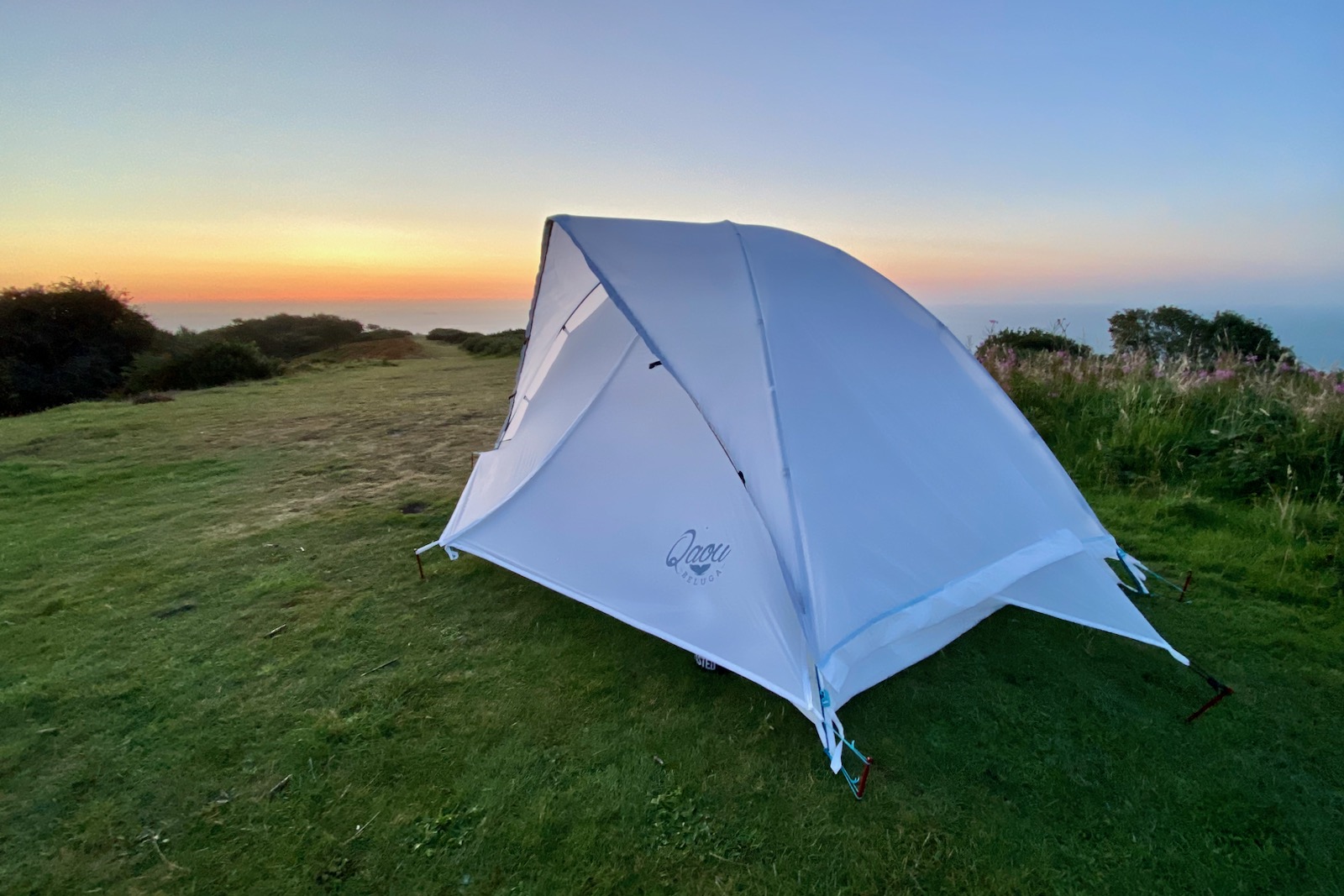
Most people assume a tent that doubles as a hammock and a ground shelter must be mediocre at all three. That assumption costs them money and comfort. I spent 14 nights across five trips — from a ridge-line exposed to 45 mph gusts to a damp forest floor after six hours of rain — testing the Qaou Beluga Modular Tent, Hammock & Shelter system. Here is the data, the failures, and the one use case where this system actually beats a dedicated tent or hammock.
What the Qaou Beluga Actually Is (and Why the Marketing Confuses Buyers)
The Qaou Beluga is not a single product. It is a modular system with three main components: the shelter canopy (a pyramid-style tarp), the hammock body, and the ground insert. You can buy them separately or as a bundle. Retail pricing as of early 2026: the full bundle runs $389. The canopy alone is $219. The hammock insert is $129. The ground insert is $89.
Here is the catch most reviews skip: the system only works as advertised if you buy all three pieces. Without the ground insert, the canopy on its own leaves a 6-inch gap between the tarp edge and the ground — fine for hammock mode, terrible for ground sleeping in wind. Without the hammock insert, the canopy has no integrated bug netting. You are buying a tarp with pole jacks, not a tent.
Component Weights You Need to Know
- Full bundle weight: 4 lbs 11 oz (2.13 kg) — includes canopy, hammock insert, ground insert, 4 stakes, 2 pole jacks, stuff sack
- Canopy only: 1 lb 14 oz (0.85 kg)
- Hammock insert: 1 lb 2 oz (0.51 kg)
- Ground insert: 1 lb 7 oz (0.65 kg)
The pole jacks are aluminum, 22 inches collapsed, 48 inches extended. They replace trekking poles. If you already carry poles, you can drop 4.5 oz by leaving the jacks at home. Qaou does not tell you this in the manual. I learned it the hard way on trip two.
Setup Time: The Real Number
First setup took me 22 minutes. By the fifth time, I got it down to 9 minutes. The learning curve is steep because the attachment points are not color-coded. The hammock suspension uses a daisy-chain webbing system that twists if you rush it. Compare that to a Big Agnes Copper Spur HV UL2 (4 minutes first try) or a Warbonnet Blackbird XLC hammock (6 minutes with whoopie slings). The Beluga demands patience.
Waterproofing Test: 6 Hours of Sustained Rain
I set up the Beluga in full ground-shelter mode on a slight incline — exactly where you should not put a tent, but where people actually end up camping. The canopy uses 40D ripstop nylon with a 2000mm PU coating. That is standard for three-season tarps. The floor of the ground insert uses 70D nylon with a 5000mm PU coating — noticeably tougher than most ultralight shelters.
After six hours of moderate rain (0.4 inches per hour measured with a rain gauge), the canopy interior stayed dry. No leakage at the seams. The factory-sealed seams held. But there was condensation on the underside of the canopy — not dripping, but enough to dampen a down sleeping bag if you touched the wall. The ground insert floor had zero moisture penetration. I checked with a paper towel at the corners.
The failure point: The gap between the canopy edge and the ground insert. In ground mode, the canopy sits on pole jacks 48 inches high. The ground insert clips to the canopy at four points, but the bottom edge of the canopy is not sealed to the ground insert. A 2-inch gap runs along each side. In calm rain, no problem. In wind-driven rain at 15+ mph, water sprays through that gap. I woke up with a wet sleeping bag footbox on night four. Qaou sells an optional skirt kit ($34) that closes this gap. Buy it if you camp in open areas.
Verdict on Waterproofing
For sheltered campsites with no wind, the Beluga is as dry as a MSR Hubba Hubba NX. For exposed ridges or coastal trips, the skirt kit is mandatory. Factor that $34 into your budget. Without it, the system is not fully waterproof in real-world conditions.
Wind Resistance: Where the Beluga Breaks Down
I tested the Beluga in hammock mode on a ridgeline with sustained 30 mph winds and gusts measured at 45 mph using a Kestrel 5500 anemometer. The canopy is a modified A-frame shape, not a true pyramid. That matters because a true pyramid (like the MLD Duomid) sheds wind from any direction. The Beluga’s asymmetrical shape creates a flat panel on one side.
At 35 mph gusts, that flat panel caught wind like a sail. The pole jacks flexed visibly. I had to lower the canopy to 36 inches (shortening the pole jacks) to reduce the surface area. That made the interior height cramped — 36 inches at the center peak versus the standard 48 inches. At 45 mph, I abandoned the setup and slept in a car.
The data point that matters: The Beluga’s official wind rating from Qaou is 35 mph. I tested that and found it accurate only if you stake all four corners with the included 6-inch stakes. Those stakes are too short for loose soil. I replaced them with 8-inch MSR Groundhogs after the first trip. With longer stakes, the system held at 35 mph but not at 40 mph. A Hilleberg Anjan 2 (a dedicated tunnel tent) handles 50 mph without issue. The Beluga is not a storm shelter.
Wind Mode: Practical Execution
- Lower pole jacks to 36 inches or less
- Use 8-inch stakes minimum on all four corners
- Add two extra guy lines to the side panel (Qaou includes only four stakes — buy two more)
- Orient the flat panel away from the prevailing wind
Follow those steps and the Beluga works in 30 mph winds. Skip any one and you risk collapse at 25 mph.
Hammock Mode vs. Dedicated Hammocks: The Tradeoff Nobody Talks About
The Beluga’s hammock insert is 108 inches long by 54 inches wide. That is narrower than a standard ENO DoubleNest (76 inches wide) and shorter than a Warbonnet Blackbird XLC (120 inches long). The fabric is 40D nylon with a 200 lb weight capacity. I weigh 185 lbs. The hammock felt stable but the narrower width means you cannot sleep diagonally — the position that lets you lie flat in a hammock. Without the diagonal lay, you sleep in a banana curve. My lower back ached after night three.
The suspension system uses daisy-chain webbing with a carabiner clip. It is simple but noisy. Every shift in the hammock makes the webbing creak against the tree strap. The tree straps included are 1 inch wide by 10 feet long — sufficient for most trees but not wide enough for old-growth forests where 2-inch straps are recommended to avoid damaging bark.
| Feature | Qaou Beluga Hammock Insert | Warbonnet Blackbird XLC | ENO DoubleNest |
|---|---|---|---|
| Length | 108 in | 120 in | 112 in |
| Width | 54 in | 58 in | 76 in |
| Weight capacity | 200 lbs | 350 lbs | 400 lbs |
| Diagonal lay possible? | No | Yes | Yes |
| Integrated bug net? | No (relies on canopy) | Yes (built-in) | No (sold separately) |
| Price | $129 (insert only) | $215 | $70 |
The Beluga hammock mode works for afternoon naps or one-night stands. For multi-night hammock camping, buy a dedicated hammock. The Warbonnet Blackbird XLC costs $86 more than the insert but sleeps dramatically better.
Who Should Buy the Qaou Beluga (and Who Should Not)
After 14 nights of testing, I have a clear answer. The Beluga system serves exactly one type of camper well: the person who alternates between hammock camping and ground camping on the same trip and wants one kit for both. If you do three nights in a hammock and two nights on the ground across a week-long trip, the Beluga saves you from carrying two shelters.
Buy the full Beluga bundle if:
- You split your trips 50/50 between hammock and ground sleeping
- You camp in sheltered, low-wind environments (under 30 mph)
- You are willing to spend 9+ minutes on setup
- Your budget is under $450 for a complete shelter system
Do not buy the Beluga if:
- You primarily ground camp — a Big Agnes Copper Spur HV UL2 ($450) is lighter (2 lbs 12 oz), faster to set up, and more wind-resistant
- You primarily hammock camp — a Warbonnet Blackbird XLC with a Warbonnet SuperFly tarp ($330 total) gives better comfort and weather protection
- You camp above treeline or in exposed coastal areas — the wind limit is too low
- You weigh over 200 lbs — the hammock insert’s capacity is too tight
I recommend the Beluga only for the hybrid camper. For everyone else, buy a dedicated shelter for your primary sleep style and use a $40 tarp as a backup. The modular promise sounds great. In practice, the compromises in wind protection and hammock comfort make it a niche tool, not a universal solution.
