
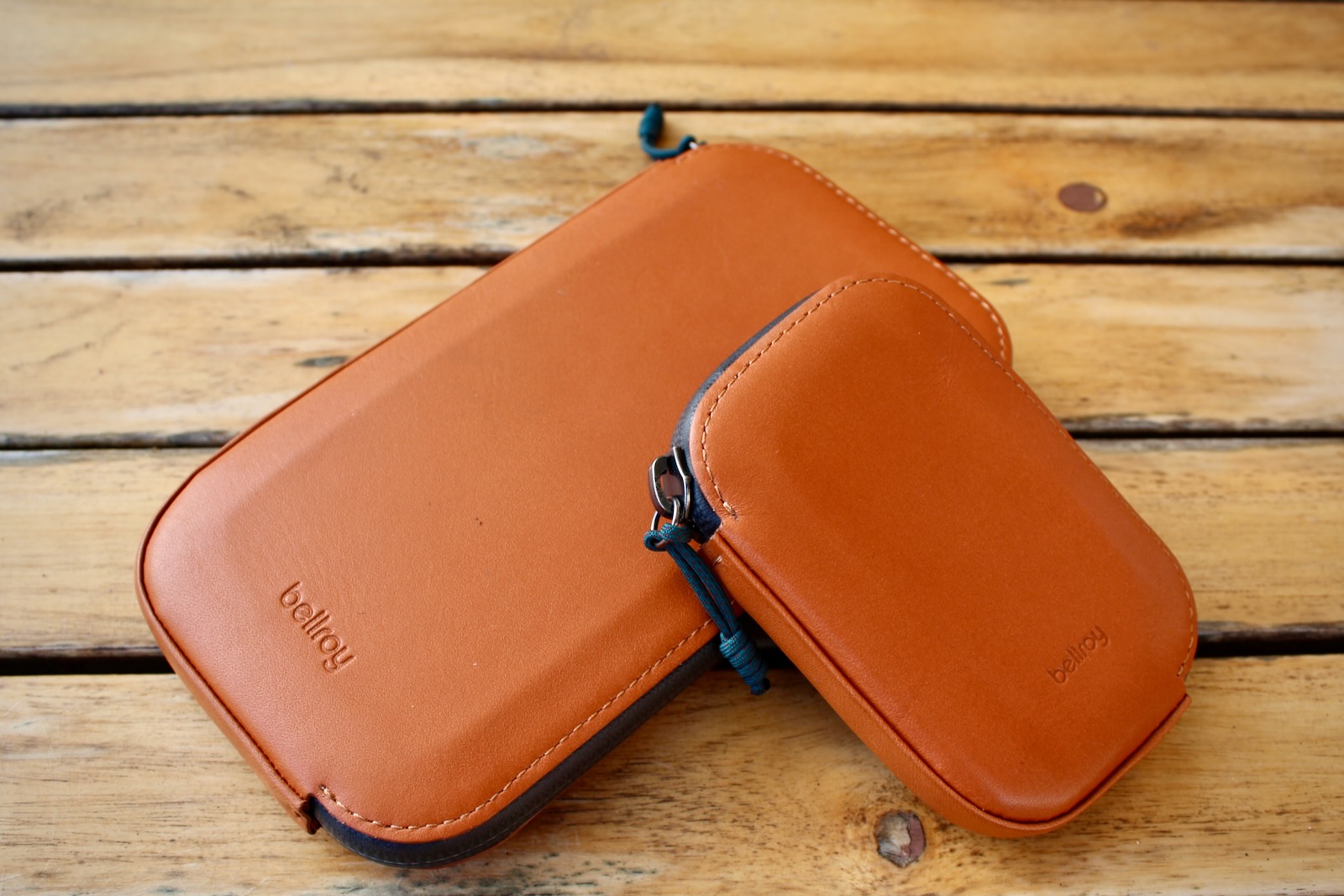
Can a single sleeve genuinely replace your phone case and your wallet?
That’s the core promise behind the Bellroy All-Conditions Phone Pocket. It’s an $89 weatherproofed sleeve that holds your phone and up to three cards — no separate wallet needed, theoretically. For people who obsess over carry minimalism, the pitch is immediately appealing. For everyone else, it raises an obvious question: why pay $89 when a $45 Peak Design wallet clipped to a $25 case solves the same problem?
The answer depends on one thing: whether the weatherproofing actually changes your life, or whether it’s just a marketing angle dressed up in outdoor aesthetics.
Independent review. No affiliation with Bellroy. Not a sponsored post.
The Real Problem with Carrying a Phone and Wallet Separately
Before getting into the product, it’s worth being honest about the actual problem this category solves — because the phone-wallet combo market is packed with products solving problems most people don’t actually have.
The genuine friction of two separate carry items shows up in specific situations: airport security lines where you’re emptying four pockets instead of two, morning runs where you can’t carry a full wallet but need a transit card, or long travel days where everything needs to fit in one jacket pocket. In those moments, a combined phone-and-cards solution reduces real friction.
The rest of the time? Carrying a slim card wallet and a phone in separate pockets is not a crisis. The phone-wallet category is partly solving a real problem and partly selling an aesthetic. Knowing which camp you fall into is the key question before spending any money here.
The specific failure point of most phone-wallet combos is that they ask your case to do two jobs at once. A case optimized for card storage tends to be thicker. A case optimized for drop protection tends to grip cards poorly. The handful of products that balance both well charge a premium — and that’s exactly where Bellroy positions itself.
There’s also a risk factor worth naming. Your cards are now physically attached to your phone. Lose one, lose both. If the card slot wears out prematurely, you’re suddenly without a payment method at a checkout line. These are real tradeoffs worth pricing in before you commit.
What Bellroy Built and What It Actually Costs
The All-Conditions Phone Pocket is a sleeve-style case — your phone slides in and out rather than snapping on. The exterior uses a weatherproof woven fabric with a DWR (durable water repellent) coating. The interior is smooth to protect your screen and display. A card slot stitched into the back holds two cards comfortably, three if you’re willing to push it.
The Specs That Matter Before You Buy
Price: $89 USD. Card capacity: 2 comfortable, 3 maximum. The card slot is open-top with no magnetic retention, which means cards can theoretically slide free if the pocket is inverted sharply. In practice the leather grips tightly enough that this is rarely a real-world issue — but it’s a design limitation worth understanding before handing over $89. Available for iPhone 15 and 16 series, iPhone 14 series, and select Samsung Galaxy models as of 2026. The sleeve adds roughly 3–4mm to overall phone thickness — slim enough for tight denim pockets, which matters for exactly the minimalist use case this product targets.
Build Quality: What Bellroy’s Reputation Actually Delivers
Bellroy has spent over a decade building credibility on construction quality, and the All-Conditions Phone Pocket reflects that. The woven exterior is tight-woven and noticeably denser than most weather-treated fabrics at this price point. Stitching is even throughout. The leather card slot has a break-in period — it starts stiff and loosens over 2–3 weeks of daily use, eventually molding to the specific cards you carry.
Bellroy backs all products with a 3-year warranty against manufacturing defects. For an $89 purchase, that’s meaningful insurance — it turns a potential stitching failure from a $89 loss into a free replacement.
What “All-Conditions” Actually Means — and Where It Falls Short
Does DWR make this waterproof?
No. DWR (durable water repellent) causes water to bead up and roll off a surface rather than soaking in. It’s the same treatment found on weatherproof jackets from Patagonia, Arc’teryx, and The North Face. It handles light rain, morning drizzle, and splashes well. It does not provide sealed waterproofing for submersion or sustained heavy rain.
The Bellroy All-Conditions Phone Pocket carries no IPX rating. There are no sealed seams. Water will eventually penetrate the woven exterior in extended downpours. Bellroy’s own language uses “weatherproof” — not “waterproof” — and that distinction is doing real work. The marketing imagery shows people in misty mountains, not under waterfalls, for a reason.
When does the coating actually help?
Daily commuters in wet climates. Cyclists caught in unexpected showers. Travelers constantly pulling their phone out in variable weather. For those use cases, DWR is a genuine upgrade over bare leather, which stains and warps with regular moisture exposure. A standard Bellroy leather Phone Pocket ($79) exposed to daily light rain for six months looks noticeably worse than the All-Conditions version at the same age.
The DWR coating also keeps the fabric cleaner day-to-day. Light grime, surface oil, and moisture wipe off rather than absorbing. Over 12–18 months of heavy daily use, this visual difference compounds. The All-Conditions version holds its appearance longer — relevant if you’re spending $89 on something you expect to use for three-plus years.
What’s the coating’s lifespan?
This is the honest limitation Bellroy doesn’t lead with. DWR coatings degrade over time, particularly with heavy friction and heat. On a jacket you can wash and re-treat with a product like Nikwax TX.Direct, DWR restoration is straightforward. On a phone sleeve that’s harder to treat properly, the weatherproofing fades gradually — and by year two or three of heavy use, the All-Conditions version may perform closer to an untreated fabric case than when new. This doesn’t make it a bad purchase. It makes it a purchase with a time horizon on its key differentiating feature.
Bellroy vs. Peak Design vs. Apple: Direct Numbers
| Product | Price | Card Capacity | Weather Resistance | Drop Protection | MagSafe Compatible |
|---|---|---|---|---|---|
| Bellroy All-Conditions Phone Pocket | $89 | 2–3 cards | DWR coated | Minimal (sleeve only) | No |
| Peak Design Mobile Wallet V4 | $45 | 3–5 cards | None | Requires separate case | Yes (compatible case needed) |
| Apple MagSafe Wallet (FineWoven) | $59 | 3 cards | None | Requires separate case | Yes (iPhone 12+ only) |
| Moment Folio Case | $40–$55 | 2–3 cards | None | Basic folio-level protection | No |
| Herschel Charlie RFID Wallet Case | $28–$35 | 3–4 cards | None | Basic sleeve | No |
Bottom Line: The Bellroy premium is real — $89 versus $28–$45 for the next-best tier. You are paying specifically for DWR treatment and Bellroy’s proven build quality. The Peak Design V4 wins on card capacity and modularity for iPhone users. The Apple MagSafe wallet wins on ecosystem integration for households already committed to Apple accessories. Neither has weatherproofing. If rain protection is not a factor in your actual daily life, there is no rational argument for the extra $40–$60.
Five Reasons to Skip This and Buy Something Else
- You drop your phone more than twice a year. This is a sleeve. It provides essentially zero impact protection from drops. The Otterbox Defender Series at $50 protects your hardware. Pair it with a $45 Peak Design wallet and you’ve spent $95 — comparable to this product — but with actual drop protection plus higher card capacity.
- You consistently carry more than three cards. Two cards fit cleanly. Three is tight. If your daily carry includes an ID, two payment cards, a transit card, and a health insurance card, you will rotate cards in and out daily or cram four into a slot rated for three. The leather stretches and loses grip faster under that load.
- You use wireless charging daily. Removing your phone from a sleeve every time you want to charge wirelessly is a small but compounding annoyance. At your desk, in your car, on your nightstand — it adds friction every single day. MagSafe-compatible ecosystems like Peak Design handle this without any extra step.
- You upgrade phones every year. The Bellroy sleeve is cut precisely for a specific model. A new phone means a new sleeve at $89. On an annual upgrade cycle, that’s $89/year just for the case. The Peak Design V4 wallet works across their expanding case ecosystem and survives phone transitions without repurchase.
- You work in seriously wet environments regularly. For beaches, boats, kayaking, or hours-long rain exposure, DWR is not sufficient to protect a $1,000+ device. The Catalyst Total Protection case ($70–$90) with separate card storage is the appropriate tool for those conditions. Don’t lean on a weatherproofed sleeve when IP68 waterproofing is what the situation actually demands.
The Right Person for This Product Is More Specific Than the Marketing Suggests
Buy this if you commute daily through unpredictable weather, carry exactly 2–3 cards, and have no drop-protection history with your current phone. That profile is real — it’s just narrower than Bellroy’s outdoor-lifestyle imagery implies.
The specific person who gets full, daily value from this product: someone who cycles or walks to work in a city with variable weather, carries a transit card, one credit card, and an ID, and has watched a previous leather wallet get ruined by light rain over six months. For that person, the DWR coating pays off every single wet commute.
Bellroy’s construction longevity reinforces the value over time. Their standard leather wallets routinely last five to seven years with heavy daily use. The All-Conditions version, with its more durable woven exterior, should perform similarly or better. Amortized over five years, $89 works out to roughly $17.80 per year — competitive with fashion wallets replaced annually at $20–$30.
Where the value calculation breaks down is for fair-weather users. If you live in a dry climate, mostly move between home, office, and car, or rarely encounter rain, the weatherproofing is an expensive feature you will never use. The standard Bellroy Phone Pocket at $79 performs identically for those users and saves $10. The Peak Design V4 at $45 saves $44 and holds more cards.
Bellroy has not made an inferior product. The All-Conditions Phone Pocket is thoughtfully designed and genuinely well-built. The problem is that its ideal user is narrower than the brand’s marketing reach, which means a meaningful portion of buyers are paying a weather premium for something they encounter once a month.
The Verdict
The Bellroy All-Conditions Phone Pocket earns its $89 price tag for one specific buyer: someone in a wet climate who carries three cards or fewer and doesn’t need a hardshell case. For everyone else, the Peak Design Mobile Wallet V4 at $45 paired with a proper protective case is the smarter spend — more flexible, better card capacity, and $44 cheaper. The Bellroy wins in the rain. Peak Design wins everywhere else.
