
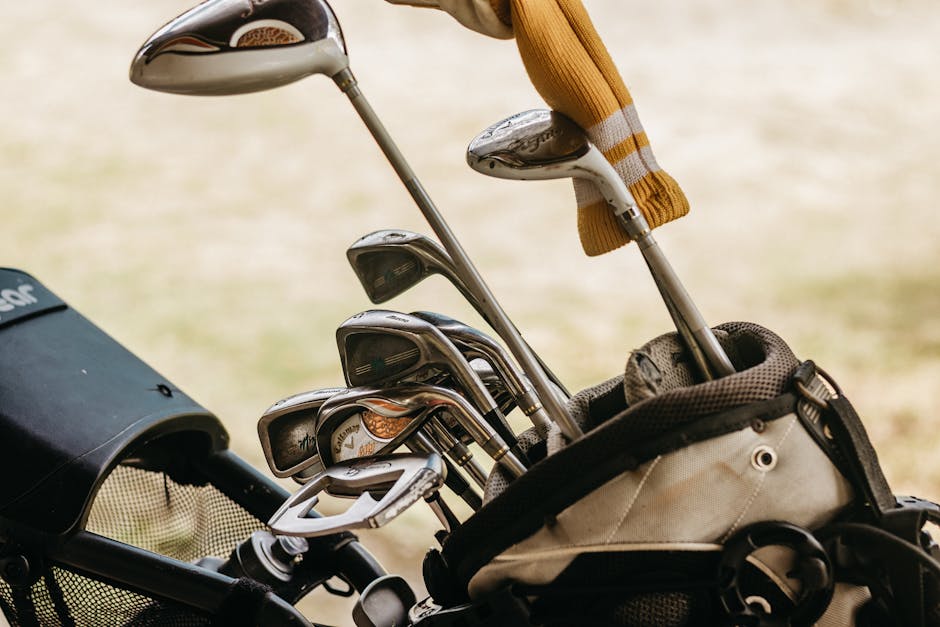
It’s a surprising fact: over 80% of amateur golfers play with clubs not optimally fitted for their swing speed or style. This often adds 5-10 strokes per round. Choosing the right golf clubs in 2024 is less about finding a magic bullet and more about matching technology to your specific game. The market offers refined designs, advanced materials, and precise manufacturing, making informed decisions crucial for performance gains.
Understanding Driver Technology in 2024
Drivers in 2024 focus heavily on optimizing ball speed, launch, and spin through innovative material distribution. Manufacturers are pushing the limits of legal clubface size and material science to deliver more forgiveness and distance across the face. This means mishits still carry reasonable distance, and well-struck shots soar further.
Carbon Crown Integration
Modern drivers, like the Callaway Paradym Ai Smoke Max ($599.99) and the TaylorMade Qi10 Max ($599.99), heavily feature carbon fiber in their crown construction. This material is significantly lighter than traditional titanium, allowing engineers to redistribute weight lower and deeper within the clubhead. The result? A lower center of gravity (CG), which promotes higher launch angles and reduced spin. For golfers struggling with slices or low-flying shots, this redistribution helps square the face at impact and get the ball airborne more easily. It also increases the moment of inertia (MOI), making the club more stable through impact.
Adjustable Weighting Systems
Many top drivers now include sophisticated adjustable weighting systems. The PING G430 Max 10K ($599.99), for instance, offers a 25-gram tungsten back weight that can be shifted to influence shot shape. Moving the weight towards the heel can promote a draw bias, effectively countering a slice. Shifting it towards the toe encourages a fade. The TaylorMade Qi10 LS, aimed at lower handicappers, offers a sliding track system that allows for micro-adjustments in weight distribution, fine-tuning launch and spin characteristics. This adjustability means a single driver head can be customized to suit varying swing paths and desired ball flights, extending the club’s utility and preventing the need for frequent replacements.
AI-Designed Clubfaces
Artificial intelligence plays a significant role in 2024 driver design. Brands like Callaway use AI to simulate millions of impacts, optimizing the thickness and contours of the clubface. The Paradym Ai Smoke line boasts an Ai Smart Face, which claims to create micro-deflections across the face for maximum ball speed, even on off-center hits. This translates to a larger sweet spot and more consistent distance, even when contact isn’t perfect. This technology is a direct benefit for amateur golfers, minimizing the penalties for slight mishits and boosting confidence off the tee.
Iron Sets for Mid-Handicappers: What to Prioritize
For mid-handicappers (generally 10-20 handicap), irons need to strike a balance between forgiveness, feel, and workability. The goal is consistent contact, reasonable distance, and enough feedback to improve. Prioritizing the right features can significantly impact your iron game.
- Forgiveness: Look for irons with a larger clubhead and a cavity-back design. These designs move weight to the perimeter of the club, increasing the MOI and making the club more resistant to twisting on off-center hits. This means shots hit towards the toe or heel will still fly relatively straight and retain more speed. Brands like PING (e.g., G430 irons, around $175 per club) and Callaway (e.g., Paradym Ai Smoke irons, around $199 per club) excel here, offering game-improvement features that truly help.
- Loft and Launch: Many modern game-improvement irons feature stronger lofts (e.g., a 7-iron might be 30 degrees instead of 34 degrees). While this can lead to longer distances, ensure the iron set provides appropriate gapping between clubs to avoid awkward distance gaps. Also, consider irons with a low and deep center of gravity to promote higher launch, making it easier to get the ball up in the air for better carry distance, especially with longer irons.
- Feel and Feedback: While forgiveness is key, you still want some feel. Irons with multi-material constructions, often incorporating urethane inserts behind the face, can provide a softer feel at impact without sacrificing ball speed. This gives enough feedback to understand where you’re striking the ball, which is vital for improvement. For example, the Titleist T350 irons ($171 per club) offer a good blend of forgiveness and a more refined feel, appealing to players who want to progress.
- Shaft Choice: The right shaft is critical. For many mid-handicappers, a lightweight steel shaft (e.g., KBS Tour Lite or True Temper Dynamic Gold 105) or a graphite shaft (e.g., UST Mamiya Recoil) with a mid-kick point is ideal. This helps maintain clubhead speed while providing stability. A professional fitting will confirm the optimal flex and weight for your swing.
Wedge Gapping Essentials for Consistent Play
Proper wedge gapping is often overlooked but is fundamental for scoring. Having consistent distance gaps between your pitching wedge, gap wedge, sand wedge, and lob wedge ensures you have a club for every yardage around the green and from shorter approaches. In 2024, wedge technology focuses on grind options and groove designs to maximize spin and versatility.
Determining Your Lofts
Start by measuring the loft of your pitching wedge. Most modern pitching wedges range from 43 to 46 degrees. From there, you’ll want to maintain 4-5 degree increments between your wedges. So, if your pitching wedge is 45 degrees, your gap wedge should be around 50 degrees, your sand wedge 54-55 degrees, and your lob wedge 58-60 degrees. This creates predictable distance gaps, allowing you to hit full swings with each wedge and know your exact yardage. Brands like Vokey (e.g., SM10 wedges, $189.99) and Callaway (e.g., Jaws Raw wedges, $179.99) offer a wide range of loft options to fill these gaps precisely.
Understanding Bounce and Grind
Bounce is the angle from the leading edge to the lowest point of the sole. It prevents the club from digging into the turf or sand. High bounce (10-14 degrees) is excellent for soft conditions or golfers with a steep angle of attack. Low bounce (4-8 degrees) works well for firm conditions and players with a shallow attack angle. Medium bounce (8-10 degrees) is versatile for most players and conditions. Grind refers to the shaping of the sole. Different grinds offer varying levels of versatility around the green. For instance, a wider sole with more bounce (like Vokey’s F Grind) is great for full shots and bunkers, while a narrower, C Grind allows for more shot-making from tight lies. Matching bounce and grind to your local course conditions and swing type is critical for consistent contact.
Groove Technology for Spin
Wedge grooves are designed to channel away water and debris, allowing the clubface to grip the ball for maximum spin. Manufacturers continually refine groove patterns. Vokey SM10 wedges feature Spin Milled grooves that are individually cut for each loft. Lower lofts (46-54 degrees) have narrower, deeper grooves for full shots, while higher lofts (56-62 degrees) have wider, shallower grooves for chip and pitch shots. This customization ensures optimal spin performance across your wedge set. Callaway’s Jaws Raw wedges use a raw face finish that promotes more friction, leading to increased spin and control on short shots. Maintaining sharp grooves is essential; consider replacing wedges every 60-80 rounds if you play frequently.
Putters: Mallet vs. Blade Design Verdict

For most amateur golfers, especially those with a slight arc in their putting stroke, a mallet putter is the superior choice. Its inherent stability and alignment aids significantly outperform the traditional blade for consistent performance.
Mallet putters, such as the Odyssey Ai-ONE Seven Putter ($299.99) or the TaylorMade Spider Tour V Putter ($349.99), offer a higher moment of inertia (MOI) due to their larger heads and weight distribution. This means they are more resistant to twisting on off-center hits, leading to fewer pushed or pulled putts. The larger head also provides ample space for alignment lines and shapes, which simplifies the aiming process. For golfers who struggle with keeping the putter face square through impact, the mallet design offers a built-in advantage. While blade putters, like the Scotty Cameron Super Select Newport 2 ($449), offer a classic look and excellent feel for very precise strokes, they demand a more perfect strike and are less forgiving of minor errors. For the average golfer seeking to reduce three-putts and gain confidence on the green, the stability and visual assistance of a mallet are invaluable.
Hybrid and Fairway Wood Selection Guide
Choosing between hybrids and fairway woods depends on your typical playing conditions, swing speed, and confidence with longer clubs. Both fill similar distance gaps, but their designs cater to different needs.
| Feature | Hybrid Clubs | Fairway Woods |
|---|---|---|
| Head Size | Compact, iron-like | Larger, wood-like |
| Shaft Length | Shorter (similar to long irons) | Longer |
| Turf Interaction | Excellent from rough and tight lies | Best from clean lies (fairway) |
| Launch Angle | Higher, easier to get airborne | Mid-high, powerful trajectory |
| Forgiveness | High (iron-like workability with wood-like distance) | High (larger sweet spot) |
| Typical Price (2024) | $219 – $299 | $299 – $349 |
| Recommended For | Golfers replacing long irons, those who struggle from rough, steep swingers | Golfers needing maximum distance off the tee (alternative to driver) or from the fairway, sweeping swingers |
| Example Models | TaylorMade Stealth 2 Rescue, PING G430 Hybrid | Callaway Paradym Ai Smoke Max Fairway, Titleist TSR2 Fairway |
For most recreational golfers, hybrids offer a significant advantage due to their versatility and ease of use. They are easier to hit consistently from various lies – including light rough and tight fairway lies – compared to long irons or even some fairway woods. If you struggle with your 3, 4, or 5-iron, replacing them with hybrids (e.g., a 19-degree 3-hybrid or a 22-degree 4-hybrid) will likely lower your scores. Fairway woods still have their place, particularly for golfers who need maximum distance off the tee on shorter par-4s or from the fairway on long par-5s, and who consistently make clean contact. For instance, the Callaway Paradym Ai Smoke Max Fairway ($349.99) delivers exceptional ball speed and forgiveness, making it a strong choice for golfers who prioritize distance.
The Impact of Shaft Flex on Ball Flight

The shaft is the engine of the golf club, and its flex profoundly influences ball flight. Choosing the correct shaft flex for your swing speed is crucial for optimizing distance, accuracy, and consistency. A shaft’s flex refers to its ability to bend during the golf swing. This bending and unbending – known as loading and unloading – is what generates clubhead speed and transfers energy to the ball.
Understanding Flex Categories
Shafts are typically categorized by flex: Ladies (L), Senior (A/M), Regular (R), Stiff (S), and Extra Stiff (X). These categories correspond to specific swing speed ranges. For example, a regular flex shaft is generally suitable for swing speeds between 85-95 mph, while a stiff flex is for 95-105 mph. If your swing speed is too slow for a stiff shaft, the shaft won’t fully unload, leading to a loss of distance and often a slice due to an open clubface. Conversely, if your swing speed is too fast for a regular shaft, the shaft will over-flex, leading to a loss of control, an inconsistent impact, and often a hook due to a closed clubface.
Influence on Launch and Spin
A shaft that is too stiff for your swing will typically result in a lower launch angle and higher spin rate, because the clubhead isn’t able to deliver the full energy transfer. This combination can lead to a ballooning ball flight that robs you of distance. On the other hand, a shaft that is too flexible for your swing can cause the clubhead to lag or lead too much, making it difficult to control the clubface at impact. This often results in inconsistent contact, excessive spin, and wild misses. The optimal shaft flex helps achieve the ideal balance of launch and spin for your individual swing, maximizing carry distance and rollout.
Weight and Torque Considerations
Beyond flex, shaft weight and torque also play a role. Lighter shafts can help increase clubhead speed for players with slower swings, while heavier shafts offer more stability for faster, more aggressive swings. Torque is the shaft’s resistance to twisting. A lower torque shaft offers more control for strong swingers, while a higher torque shaft provides more feel for slower swing speeds. A shaft fitting considers all these factors to pinpoint the best option, often blending different characteristics for a precise match.
Club Fitting in 2024: Is It Worth the Investment?
Absolutely, yes. Club fitting in 2024 is more sophisticated and beneficial than ever, moving beyond basic static measurements to dynamic analysis using launch monitors and advanced software. It’s the single most effective way to optimize your equipment for your unique swing.
What Does a 2024 Club Fitting Involve?
A modern club fitting session s state-of-the-art technology like Foresight Sports GCQuad or TrackMan launch monitors. These devices capture precise data on ball speed, launch angle, spin rate, attack angle, club path, and more. The fitter will observe your swing with your current clubs, then recommend different head designs, shaft flexes, weights, and lengths. You’ll hit balls with various combinations, and the data will show exactly how each change impacts your performance. Expect sessions to last 60-90 minutes per club category (e.g., driver, irons, wedges) and cost between $100-$250 per session, often waived or credited towards a club purchase.
What Specific Benefits Can I Expect?
The primary benefit is optimized performance. A properly fitted driver can add 10-20 yards of carry and significantly tighten dispersion. Irons fitted to your swing will offer more consistent distances, better turf interaction, and improved accuracy. Wedges with the correct bounce and grind will make chipping and pitching easier and more effective. A fitted putter ensures proper alignment and roll. Beyond performance, fitting reduces frustration from fighting unsuitable equipment, fostering greater confidence and enjoyment on the course. It’s an investment that pays dividends in lower scores and a better golfing experience.
When Should I Get Fitted?
It’s ideal to get fitted whenever you’re considering new clubs or if your game undergoes a significant change (e.g., increased swing speed, a new swing coach). Even if you’re not buying new clubs, a “tune-up” fitting can confirm your current setup is still optimal or identify minor adjustments needed. Given the rapid advancements in club technology, a fitting every 2-3 years, especially for key clubs like the driver and irons, can ensure you’re always playing with the best equipment for your game.
The Case for Forgiveness Over Workability
For the vast majority of amateur golfers, prioritizing forgiveness in club selection will lead to lower scores and more enjoyable rounds than chasing workability. The ability to shape shots, fade or draw on command, is a skill reserved for low-handicappers and professionals. Forgiveness, however, benefits everyone.
Clubs designed for forgiveness, such as game-improvement irons or max-MOI drivers and putters, are engineered to minimize the impact of mishits. This means shots struck slightly off-center will still travel a reasonable distance and stay closer to the target line. Forgiveness reduces the penalty for imperfect swings, which are a reality for most golfers. Chasing workability often means opting for smaller, less stable clubheads that demand perfect contact. While these clubs offer more control for skilled players, they severely penalize the average golfer, leading to greater frustration and higher scores. For clubs like the Callaway Paradym Ai Smoke Max driver or the PING G430 irons, the focus on stability across the face makes them invaluable tools for consistent play, directly impacting the scorecard positively.
Final Thoughts on 2024 Club Selection
Navigating the 2024 golf club market means making informed choices that genuinely benefit your game. Focus on what directly improves your consistency and confidence, rather than just chasing the latest trend. Here’s a quick summary of key takeaways:
- Drivers: Prioritize models with carbon crowns and adjustable weighting (e.g., TaylorMade Qi10 Max, Callaway Paradym Ai Smoke Max) for optimal launch, spin, and forgiveness.
- Irons: Mid-handicappers benefit most from cavity-back designs (e.g., PING G430, Titleist T350) that offer a blend of forgiveness, sufficient distance, and a degree of feel.
- Wedges: Ensure proper gapping (4-5 degrees between lofts) and select bounce/grind options (e.g., Vokey SM10, Callaway Jaws Raw) that match your course conditions and swing style.
- Putters: For most, a mallet design (e.g., Odyssey Ai-ONE Seven, TaylorMade Spider Tour V) provides superior stability and alignment assistance compared to traditional blades.
- Fairway Woods/Hybrids: Hybrids are often the more versatile and easier-to-hit option from various lies, effectively replacing long irons for better consistency.
- Shaft Flex: A correct shaft flex is non-negotiable for maximizing distance and accuracy; professional fitting is highly recommended.
- Club Fitting: An investment in fitting pays off in optimized performance, reduced frustration, and ultimately, lower scores.
